
When Protection Becomes Exposure: Rethinking U.S. Military Bases in the Gulf

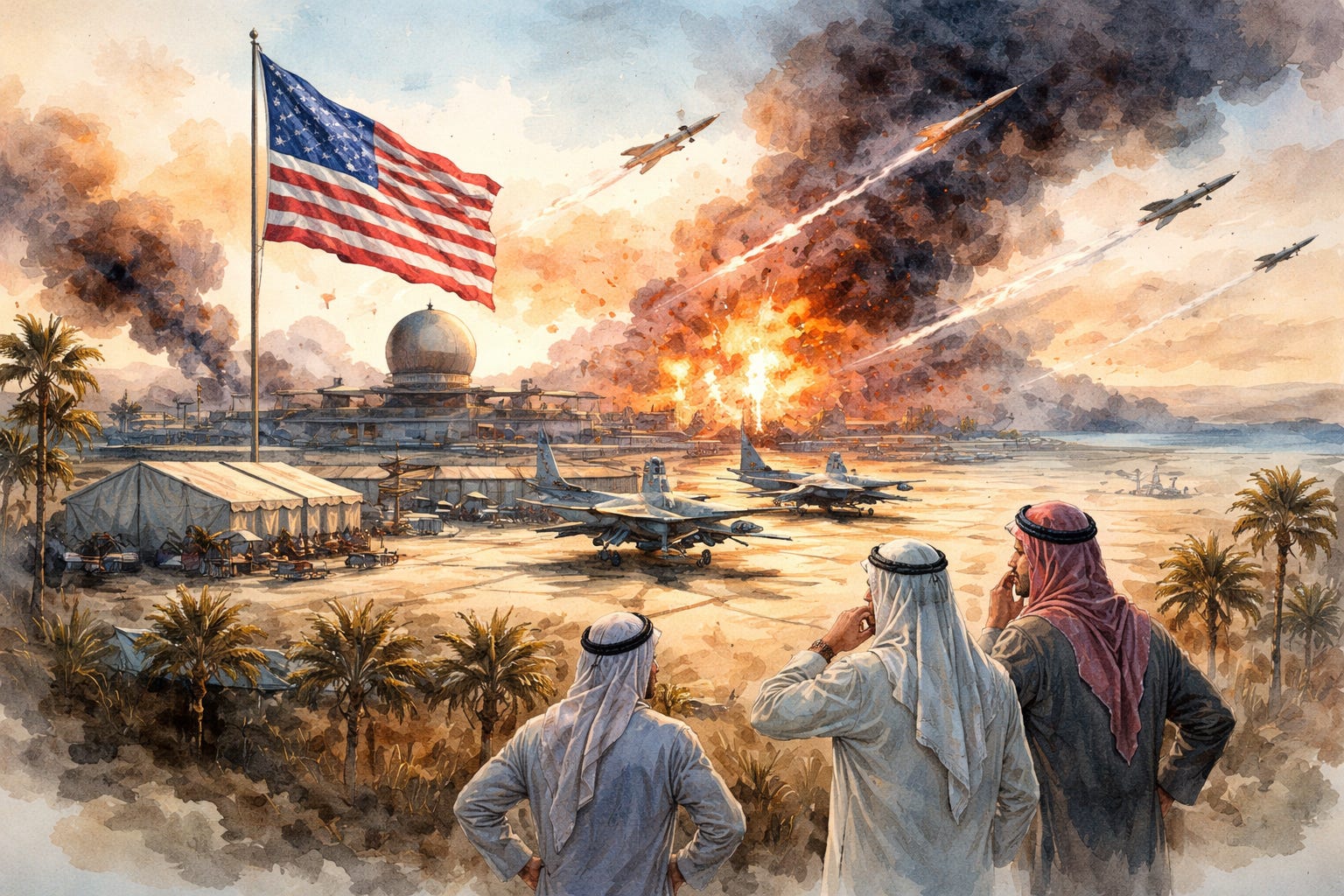
For decades, the United States’ military footprint in the Arabian Peninsula has been justified with a simple narrative: host foreign bases, and you are safer. Gulf monarchies and republics alike, from Bahrain to Qatar to Kuwait, signed defence cooperation agreements with Washington that anchored this premise. In return for hosting troops and infrastructure, local leaders were told their sovereignty would be buttressed against regional threats — from Saddam Hussein’s Iraq to an assertive Tehran.
But recent events have exposed fault lines in that logic, prompting leaders and scholars across the region to ask with increasing candour: Does this arrangement actually guarantee security? Or has it become a liability cloaked in strategic marketing?
The answer, emerging from public remarks and open assessments by regional diplomats and foreign policy experts, is no longer unambiguously affirmative.
The latest round of conflict — ignited by U.S. and Israeli strikes on Iran’s strategic facilities and followed by retaliatory missile and drone attacks on Gulf territory — has placed American bases directly in the crosshairs. Iranian missile salvos have struck Naval Support Activity Bahrain, the headquarters of the U.S. Fifth Fleet, causing substantial damage to radar installations. Similar assaults have hit American positions in Qatar and the broader Gulf, forcing the evacuation of most U.S. personnel to “mission‑critical” status amid heightened risk.
Such targeting is more than symbolic. It confronts Gulf states with a sobering reality: hosting U.S. forces does not immunise them from conflict; it may instead make them focal points in that conflict. As one geopolitical columnist puts it, recent attacks “have exposed a fundamental flaw” in the conventional wisdom around American bases — that they protect rather than attract hostility.
This criticism is not limited to fringe commentators. Oman’s foreign minister has publicly accused the Trump administration of being persuaded into a war with Iran that jeopardised regional stability rather than safeguarded it. He lamented the collapse of a promising diplomatic track and warned of the long‑term instability that arms and bases alone cannot mitigate.
Iran itself has seized on this narrative, urging the Arab Gulf to reconsider its reliance on external security guarantees and to deepen regional cooperation instead. Tehran’s ambassador to Saudi Arabia called for a “serious review” of Gulf ties amid ongoing hostilities, asserting that diversified, indigenous approaches to security are essential to avoid becoming proxies for great‑power disputes.
While Gulf leaders rarely eschew the language of alliance publicly, an array of analysts and commentators — both inside and outside the region — are questioning the long‑term effectiveness of the U.S. forward presence. The core of the debate is no longer whether American military assets are advanced or technologically superior; it is whether they deter aggression or simply reshape threats in ways that local governments did not fully anticipate.
Critics note that decades of military cooperation and expensive basing rights have done little to prevent missiles from crossing borders or critical infrastructure from being targeted. They argue that host states are increasingly forced to balance not just the security needs of their people but the strategic costs of being aligned so visibly with one external power.
Supporters of the status quo counter that without the U.S. presence, the strategic vacuum could invite other powers — whether Russia, China or an emboldened Iran — to exert influence more directly. They also point to historical precedents: it was U.S. leadership that assembled the coalition that liberated Kuwait in 1991 when Iraqi forces invaded, an event that swiftly reminded Gulf capitals of the perils of minimal external security support.
Yet even this argument reeks of paradox. If the original threat landscape was defined by inter‑Arab conflict and large‑scale invasions, today’s threats are far less conventional — drones, missiles, proxy militias and hybrid operations that can exploit the very presence of foreign bases as strategic leverage rather than deterrent.
The contemporary discourse in capitals from Manama to Muscat now openly acknowledges what was once unutterable: that foreign bases, even those with high‑tech defences and global reach, cannot guarantee safety in a fractious, multipolar Middle East. The question now is not merely about presence but about purpose — and whether the GCC’s security calculus remains fit for a world where lines between protector and provocation are increasingly blurred.
In the end, Arab states are asking a question that should resonate far beyond their borders: what is the price of protection if it turns you into part of the problem you sought to avoid? And more urgently, who determines whether a base protects the state — or exposes it?
In confronting these questions, the politics of basing is shifting from tacit acceptance to open contestation — an evolution that may yet reshape regional security for years to come.