
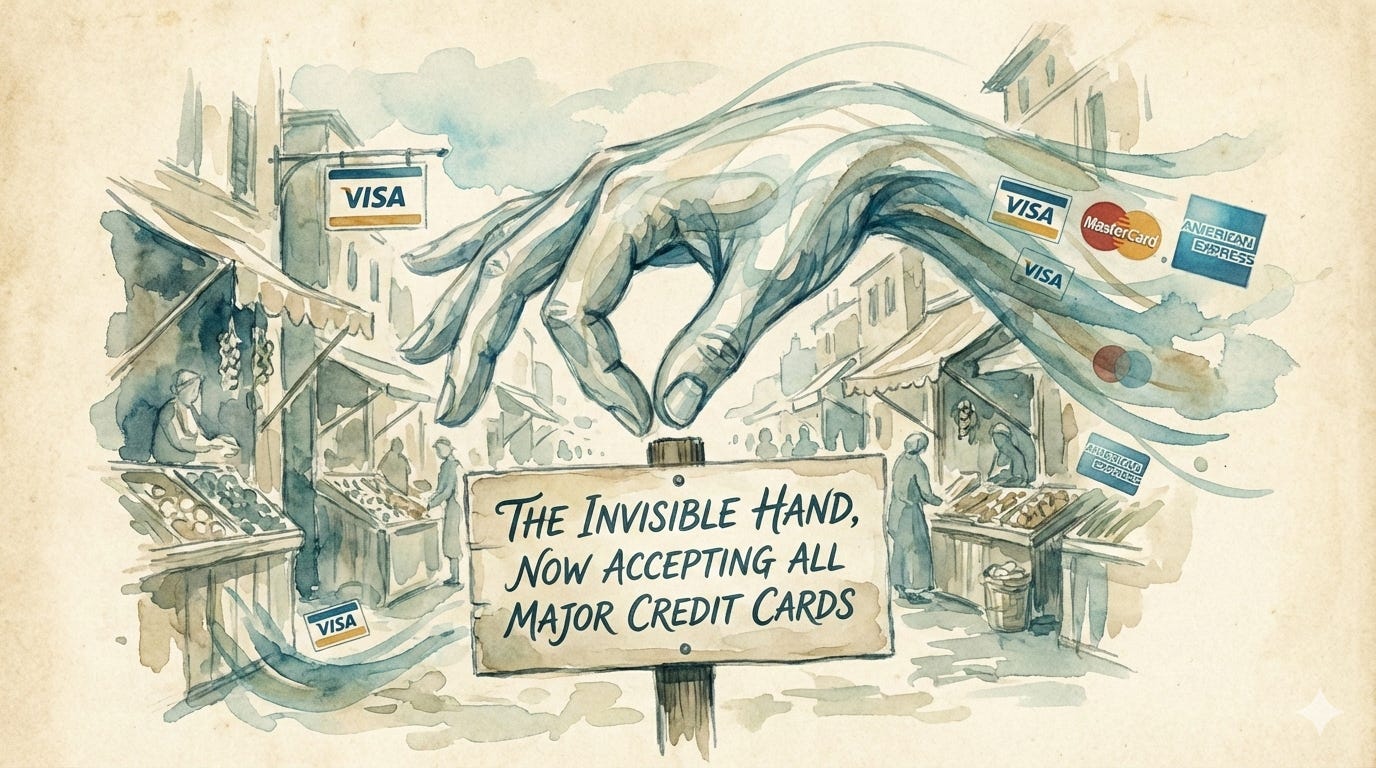
The Invisible Hand, Now Accepting All Major Credit Cards

American capitalism is the closest thing modern civilization has produced to a national religion that openly denies being one. It has its prophets (venture capitalists), its sacred texts (quarterly earnings reports), its rituals (Black Friday), and its saints (billionaires who began in garages but now require orbital launch facilities). It even has its catechism: “The market knows best.” The market, in this cosmology, is omniscient, morally pure, and deeply offended by regulation.
The official myth begins with rugged individuals, raw land, and the invisible hand gently guiding humanity toward universal prosperity. The unofficial footnote mentions land seizures, industrial monopolies, and the occasional financial panic. But that is considered bad vibes. In the land of liberty, markets are free—especially from memory.
The American variant of capitalism perfected spectacle. Where the British built empire and the Germans built industry, Americans built branding. Corporations are no longer companies; they are “ecosystems.” They do not sell products; they curate “experiences.” A cup of coffee is not coffee—it is a lifestyle statement retailing at the GDP of a small medieval duchy. If you doubt this, spend ten minutes inside a modern tech keynote, where grown adults applaud software updates as if witnessing the moon landing.
Indeed, the moon landing itself was once a government project. But we have matured. We now prefer billionaires reenacting the space race privately, because nothing says efficiency like three competing rocket companies racing to colonize Mars while public transit in major cities resembles a post-apocalyptic documentary. It is poetic: the trains are late, but at least the tweets from orbit are punctual.
The marvel of American capitalism lies in its capacity to convert everything into a market—health, education, water, attention, outrage, even loneliness. Especially loneliness. Entire platforms monetize the human need for validation, then sell it back at subscription rates. You are not depressed; you are “under-optimized.” Please upgrade to premium.
Healthcare deserves special mention, as it exemplifies the system’s moral elegance. In most developed countries, illness is unfortunate. In America, it is a financing opportunity. A broken arm is not merely a fracture; it is a networking event for insurance providers, billing departments, and collection agencies. You do not simply recover—you navigate. The bill arrives with the suspense of a thriller novel: how much will survival cost this season?
Education follows a similar logic. College is described as an investment in oneself, like purchasing stock in your own consciousness. The returns are variable; the debt is not. Students graduate fluent in theory, practice, and compound interest. They learn early that freedom means choosing between loan repayment plans. But this is empowering. Nothing builds character like a 20-year payment schedule.
Inequality, of course, is not a flaw; it is a motivational poster. The existence of billionaires reassures everyone else that the ladder is still there, even if most of the rungs have been discreetly removed for “efficiency.” If wealth concentrates upward, this is simply gravity expressing its entrepreneurial spirit. Those at the bottom are encouraged to hustle harder, ideally by starting a podcast.
Work itself has undergone a spiritual transformation. The old deal—loyalty in exchange for stability—was retired as “legacy thinking.” Today’s worker is agile, flexible, and perpetually available. You are not unemployed; you are between opportunities. You are not overworked; you are passionate. The office may have vanished into the cloud, but the expectation of constant productivity remains gloriously terrestrial.
Then there is the financial sector, the high priesthood of abstraction. Here, money begets money with minimal interference from reality. Derivatives are traded on assets that are derived from other derivatives, like financial matryoshka dolls. When the system occasionally implodes, as it did during the 2008 crisis, the explanation is reassuring: it was a “correction.” Apparently, the market had a brief existential crisis and required several trillion dollars in public funds to rediscover itself. A touching story of growth.
Consumer culture completes the circle. The citizen is primarily valuable as a buyer. Political discourse increasingly resembles brand management, and brands increasingly resemble political movements. One chooses identity through logos. Even dissent is monetized. Revolutionary aesthetics are available in multiple sizes and free shipping options.
Technology was supposed to liberate humanity from drudgery. Instead, it optimized drudgery. Algorithms monitor behavior with priestly devotion, ensuring that no desire goes untracked. The surveillance is benevolent, of course. It simply wants to know you better—so it can sell you something with greater emotional precision. If previous eras feared Big Brother, ours welcomes Big Data with open wallets.
None of this would be possible without the narrative of meritocracy. The idea that anyone can rise is repeated so frequently that it achieves liturgical status. The fact that mobility has stagnated in many sectors is treated as an unfortunate glitch, not a structural feature. The lottery remains legal, both literally and metaphorically. Hope is excellent for consumption.
The political consequences are equally theatrical. Campaigns are financed at levels that would make small nations blush, because democracy, like any premium service, requires robust funding. Lobbying is simply civic engagement with better catering. When corporations influence policy, it is called expertise. When citizens protest, it is called disruption.
And yet, despite all this, American capitalism remains astonishingly productive. It generates innovation, abundance, and spectacle at a pace that leaves critics dizzy. The problem is not that it fails to create wealth; it is that it struggles to distribute stability. It produces miracles and precarity in equal measure. It can deliver groceries to your doorstep in fifteen minutes but cannot guarantee affordable housing within fifty miles.
Perhaps the most sardonic twist is that many of its fiercest critics participate enthusiastically. Outrage trends. Boycotts require smartphones. Anti-capitalist essays are monetized with ads. The system has an almost supernatural ability to absorb resistance and resell it as content. It is less a structure than an atmosphere: one breathes it whether one approves or not.
In the end, American capitalism is neither purely villainous nor purely virtuous. It is a machine—immensely powerful, ingeniously adaptive, and chronically indifferent. It rewards risk while socializing loss. It celebrates freedom while structuring dependency. It insists that everything has a price, and then acts surprised when citizens begin to calculate the cost.
One might even admire its coherence. The creed is simple: growth is good, profit is proof, and markets are moral. Should contradictions arise, there is always another startup, another slogan, another quarterly report promising that disruption will fix what disruption disrupted. The future is perpetually bright, provided you can afford admission.
And so the experiment continues—audacious, profitable, and faintly absurd. In this grand bazaar of liberty, everything is negotiable, except the assumption that it must be for sale.