
Piers Morgan Uncensored: A Masterclass in How to Win a Debate by Never Letting One Happen

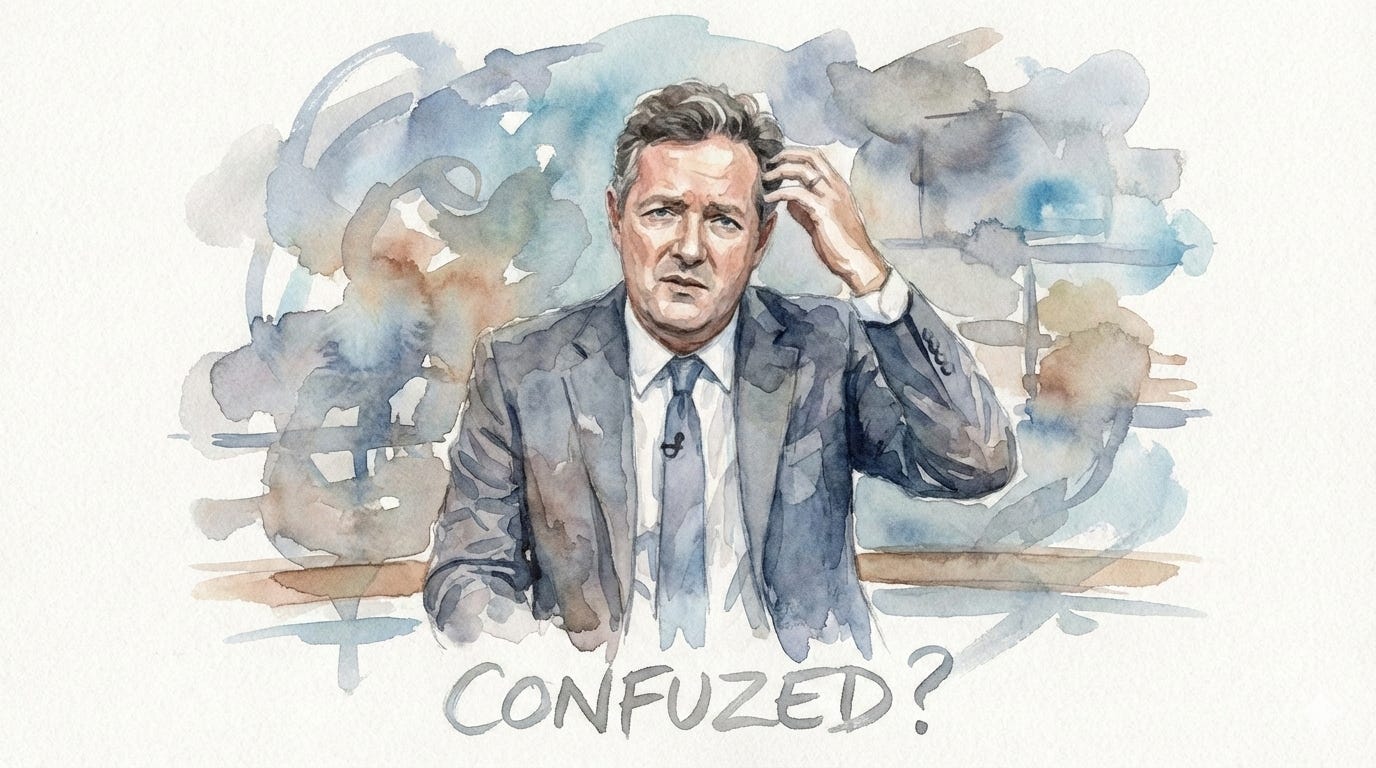
If there were an Olympic sport for interrupting, Piers Morgan would not merely win gold—he would interrupt the medal ceremony to explain why the judges are biased, the audience is woke, and the very concept of “listening” has gone too far. Piers Morgan Uncensored, despite its brave and rebellious title, is not so much a debate show as it is a televised reenactment of a man arguing with his own reflection—occasionally allowing guests to appear so he can heroically defeat them mid-sentence.
The genius of Morgan’s debating method lies in its elegant simplicity: talk louder, talk longer, and never—under any circumstances—acknowledge the existence of nuance. Why wrestle with complexity when you can bulldoze it with indignation? Why explore an idea when you can shout it down, mock it, and then accuse it of cancel culture?
Every great debate begins with curiosity. Naturally, Piers Morgan avoids this at all costs. His questions are less inquiries and more verbal bear traps—phrased in such a way that any answer except the one he prefers proves the guest is either stupid, dishonest, or secretly destroying Western civilization.
“Just answer the question!” he bellows, seconds after interrupting the answer.
This is not hypocrisy; this is performance art.
Morgan’s questions function like clickbait headlines: emotionally loaded, intellectually hollow, and engineered to provoke outrage rather than insight. They are not meant to be answered—they are meant to be survived.
Listening, in the Piers Morgan Cinematic Universe, is a dangerous slippery slope. First you let someone finish a sentence. Next thing you know, you’re considering their point. And from there, total societal collapse.
Thus, Morgan interrupts—not occasionally, not accidentally, but ritualistically, as though silence itself were a liberal conspiracy. Guests are rarely allowed to complete a thought, because a completed thought might contain logic, and logic is notoriously difficult to shout over once it fully forms.
The interruption is often accompanied by theatrical incredulity: raised eyebrows, incredulous scoffs, and the facial expression of a man who has just been told gravity is optional.
In traditional debates, victory is achieved through reasoning, evidence, and persuasion. On Piers Morgan Uncensored, victory is achieved by outlasting the other person’s vocal cords.
The louder voice is the correct voice. The angrier tone is the smarter tone. The final word—no matter how incoherent—is the truth.
If a guest remains calm, Morgan accuses them of evasion. If they get emotional, he accuses them of hysteria. If they cite data, he waves it away. If they cite personal experience, he declares it irrelevant. If they somehow navigate all of this, he pivots to something they didn’t say and argues with that instead.
Morgan’s real opponent is rarely the guest in front of him. His true enemy is a cartoon villain composite—a vaguely defined amalgamation of “the woke,” “the left,” “the snowflakes,” and “people on Twitter I don’t like.”
Guests are routinely held responsible for opinions they do not hold, statements they did not make, and movements they did not start. Correcting him only proves they are being defensive, which in turn proves he is right.
This is not misrepresentation; it is efficient storytelling. Why argue with a real person when you can argue with a simplified villain you can defeat in under three minutes?
No one champions free speech quite like a man who will not let anyone else speak.
Morgan presents himself as a fearless defender of open dialogue, bravely standing against censorship—by talking over his guests, cutting them off, and declaring their arguments “nonsense” before they finish explaining them.
Free speech, in this framework, means his freedom to speak without interruption, and everyone else’s freedom to nod while he does so.
When logic fails—and it frequently does—Morgan reaches for his most reliable tool: moral outrage. Outrage is fast. Outrage is loud. Outrage requires no footnotes.
Why engage with systemic analysis when you can look personally offended? Why examine structural issues when you can ask, “But don’t you think that’s ridiculous?” with enough disdain to count as a rebuttal?
This transforms the debate into a kind of emotional wrestling match, where whoever looks angrier is presumed to be winning.
The show loves to advertise its “balanced” panels: one guest who agrees with Morgan and one who has volunteered to be emotionally waterboarded. The agreeing guest is allowed to speak uninterrupted, while the dissenting guest is treated like a malfunctioning microphone.
Balance, here, does not mean equal time or fair treatment. It means the aesthetic appearance of opposition, safely contained and thoroughly dismantled for audience entertainment.
Piers Morgan Uncensored is not designed to enlighten, persuade, or even meaningfully argue. It is designed to perform conflict, to convert complexity into shouting matches, and to reassure viewers that the loudest person in the room is also the smartest.
And in that sense, Morgan is undeniably successful.
He has perfected a format where winning means never conceding, debating means never listening, and being “uncensored” means censoring everything except your own voice.
It is not journalism.
It is not debate.
It is not even conversation.
It is a monologue with guests—and Piers Morgan would interrupt this sentence too, if he could.